Why Mixed Renewables Make Sense on the Farm
Farms are energy consuming machines, but not all farms have the same or consistent energy needs throughout the year. Many have traditionally used a combination of diesel, utility electric or propane, which powers nearly every machine, from irrigation pumps, lights, refrigeration units, fans, electric motors, tractors, dryers, etc. The primary drawback of these options is their price tag, they fluctuate depending on supply and demand and they just cannot keep up with farmwork’s unpredictable rhythm. Energy demands fluctuate between season. It is irrigation and machinery work spring summer season, then heating and ventilation for wintertime. It ramps up again with harvesttime, when the demands go way up again for various operations. Therefore, you cannot schedule farm work on an energy balance of 0 at all times, making a single, inexpensive energy solution impractical, insufficient or completely unpredictable.
This is where a system combining multiple energy solutions can fill the needs on a farm that can shift on short notice. Each type of energy production fills different niches to round out supply, smooth demand curve, minimize the number of power outages and downtime and also reduce long-term expenses.
While the solar option runs well throughout the longer summer days, windmills operate well at night, which can fill in the gaps where the solar output decreases due to dark, inclement weather during fall or winter. Furthermore, biomass derived from such agricultural or animal waste could cover the bulk of farm heating and also provide backup power when the two energy solutions diminish in production.
This allows a smoother and much more effective integration between farms and a renewable energy plan. Instead of choosing a single method of power generation, the focus should instead be put into how to make it all come together into a unified and efficient working system.
Solar Power
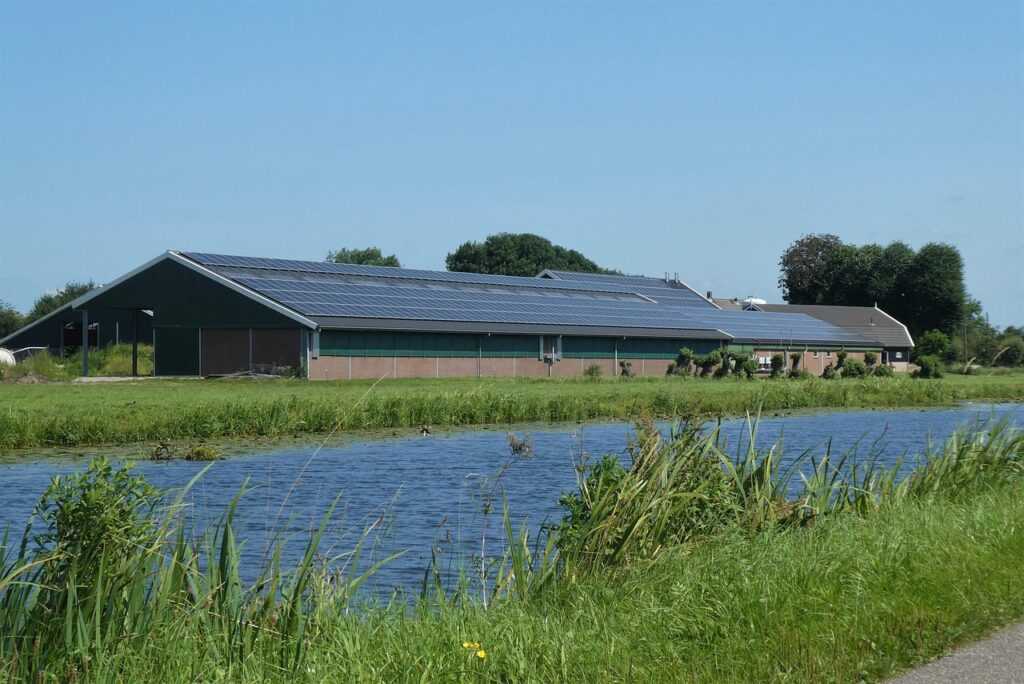
Solar energy dominates on-farm renewables. It is fairly low cost and simple to set up, running from a single panel mounted atop a barn all the way to complete roof coverage. As an added benefit, it generally works during those hours when farmers most need energy for irrigation systems, greenhouse lighting, charging up electric vehicles, tools and more. Whether your farm needs a 5 kW system to help operate lights or pumps or your farm wants to power its total operation off-grid with solar panels, the initial installation cost has been dropping.
Wind Energy
When sunlight vanishes, wind can step in. Windmills do not rely on sunlight but on clear skies and a decent breeze. Wind is an excellent power source during nighttime, during cloudy weather or when no sunshine is available. Unlike solar energy, wind power is intermittent. Solar and wind together make up a good part of a power grid. Wind is not a constant source of energy, however. Pairing solar and wind together means that there are periods where we do have power generation from wind when we do not have any generation coming from the sun. It is not that wind is the ultimate solution, but that it pairs up with another solution to create a complete system.
Biomass and Bioenergy
Biomass closes the gap where the remaining waste stream from the biomass itself can then be converted into energy. This includes crop waste, manure, forest products (such as wood chips) and even human waste, none of which would then be ending up as garbage. Farmers and greenhouse managers could use the system to keep their barns warm during winter, provide heat for their structures or on-farm buildings and can use it for heat or power during utility blackouts or when sufficient solar is unavailable. The downside of this type of energy is that it requires more setup than some other sources such as solar power, but if configured, can indeed make the total biomass system run more reliably.
Smart Storage and Grid Integration
Balancing Supply with Smart Battery Systems
Wind and solar are unreliable. Thus battery storage is required for consistent power, which is useful in the field, especially at home, for when a farmer cannot count on sunlight or wind. This saves power for periods of low output, like night or on non-windy days. Battery storage has several advantages for the farmer, including the provision of a constant stream of power for equipment, maximization of on-site solar and minimization of reliance on diesel or purchased power.
Off Grid vs. Grid Tied: What’s Best for Your Farm?
Whether going entirely off-grid or keeping itgrid-tied is your choice depends upon the particular circumstances of your farm, location and power usage.
Off-grid systems provide you complete independence from the electric company. But they also demand a significant initial outlay for the storage and backup you will need for the duration that the grid might fail and the sun might not be out for. They are generally best for remote areas not conveniently connected to a power line, for example.
Grid-tied systems allow you to sell any energy you do not immediately consume back to the electric company. By virtue of that fact, grid-connected systems need no battery storage and will never fail as long as the grid continues to exist. You will also experience more stable grid voltage, as grid electricity is generally stabilized and smooth.
Tip: Hybrid setups where farms are grid connected but have battery backups offer the most flexibility and can be scaled over time.
ROI Timelines & Incentives Farmers Shouldn’t Miss
Renewable tech is a long term investment, but shorter payback periods are increasingly common thanks to financial programs and smarter tech.
Ways to accelerate ROI:
Federal and state clean energy tax credits
Utility level rebates for grid tied systems
Grants and loan programs specific to agriculture and energy efficiency
What this means for your operation: Many farms recover their investment within 5 7 years Significant operational cost savings kick in early Reduced exposure to fluctuating fuel and energy prices
Understanding your regional programs and working with experienced installers can greatly improve your financial outcomes.
In short: smart storage and smart planning turn renewable energy from an expense into a farm asset.
Real World Proof: Multi Source Renewable Farms

” solar” solar. Wind. Biomass. ” But they exist right now: I am currently looking at data from several farms I have been consulting. First, midsize organic apple farms in upstate New York and Vermont have recently gone entirely renewable. They installed their own on-site solar. Small, single turbine wind power projects now pop up in the Corn Belt of the Midwest on even moderately sized grain operations. Second, an example: Twin Ridge Farms operates an apple orchard in Pennsylvania where they combined an on-site solar array, an 11 kw Bergey wind turbine and a large-scale biomass digester fed by local dairy waste to produce heat and power, all while simultaneously creating energy from methane and compost. After implementing their hybrid power plant, they were able to cut their diesel generator use by 80% while powering 100% of their irrigation and cutting their downtime during thunderstorms down to effectively zero.
And then there are additional non-energy advantages: several farmers on a group mailing list have mentioned improved water use due to smart systems powered by clean energy, higher yield because of tighter, clean, renewable, stable, renewable-controlled temperatures in greenhouses and grow-rooms, as well as minimal downtime in the cold storage they use to keep crops from rotting out after picking.
The number can be significant and is completely achievable. If you want a look, you should at this page which outlines five specific renewable farms that go into detail about their farms, the equipment involved, the operational changes they underwent and the sheer number of changes.
It should clear things up about why many more farms are converting to renewable energy.
Cost vs. Payoff: What Farmers Should Know Now
While installing solar arrays on a farm is not cost-prohibitive for anyone, including small hobby farms, the capital necessary for panels, turbines, storage systems and bioenergy systems is high upfront, posing a “Barrier to adoption. ” However, farms will enjoy energy independence not beholden to yearly utility price increases. Over 20-25 years, the farm will recoup initial costs and earn money afterward, especially during periods of high electricity prices or a failing power grid.
Furthermore, tax credits are widely available at the national level (e. g. , Investment Tax Credit), as well as at the state level and various grant programs, also, some programs can assist farmers with the costs, rural areas could receive more funding. Many of those incentives may reduce the farm installation cost up to 60% and sometimes less (around 30%).
By sizing the system correctly, timing the purchase/installation to meet with available grants/incentives and selecting a combination of different energy systems, the period can be reduced drastically, it might take only three to five years to see an ROI on a properly executed hybrid setup before years of profits. It is not dissimilar to building a more permanent structure or improvement such as a grain bin or a modern barn or machine shed that lasts a century and works season after season for profit or the family lifestyle on the farm.
Moving Toward a Fully Sustainable Operation
Smart farming is not hypothetical.
Smart agriculture is happening everywhere right now, solar paired with a wind turbbine and biomass generation is cutting fuel costs for a farmer (e. g. , [61]) as well as building grid independence, after such a farmer can do grid connections backup instead of a lifeline: after having enough smart farm technology in place he has enough power to run critical facilities during a grid blackout. This would also mean a smaller carbon footprint without increasing costs or decreasing reliability. As another result, fewer diesel trucks would deliver fuel to local rural communities, lowering air pollution in many cases. Furthermore, a smart farm can provide stable energy for rural towns/villages. Many renewable energy products support jobs.
Smart farming benefits both from technologies complementing each other, in a non-linear fashion: Solar energy works in daytime while the wind turbbine might only run in certain times and the bioenergy can provide power whenever the solar and wind outputs are low. Instead of just adding capacities from renewable energy sources like solar panels and wind turbbines, combining them into smart farm networks exponentially provides power in an intelligent and controllable manner, ensuring more uptime, better reliability and an even greater ROI.
If the purpose of smarter agriculture is a more fuel efficient, carbon neutral and energy secure farm, that does not buckle during unforeseen climatic circumstances or unreliable grid or expensive fossil fuel, a smart farm is more than just the next generation-it is right now.